
Cycling mobility continues to gain importance in towns and cities across Spain.
More and more people are using bicycles to commute to work, study, make short journeys or connect with public transport. This growth also brings new challenges related to coexistence, road safety and the adaptation of urban spaces.
In June 2026, the Council of Ministers approved an amendment to the General Traffic Regulations aimed at improving the protection of vulnerable road users.
The reform introduces changes that directly affect cyclists on both urban and interurban roads. These include mandatory helmet use without exceptions on interurban roads, new conditions for overtaking bicycles and specific rules for cycling in cities.
Most of these measures will come into force on 1 October 2026.
But cycling safety does not depend solely on the rules governing road traffic.
For bicycles to become an everyday alternative, local authorities and organisations must also create infrastructure that supports the entire journey: connected routes, signage, intermodality and a secure bike parking facility at the destination.
Cycling safety does not end when you reach your destination: it also requires a safe place to park your bicycle.
ARTICLE INDEX
Main changes from 1 October 2026
The most important changes for cyclists and the vehicles travelling alongside them are:
- Mandatory helmets without exceptions for cyclists on interurban roads.
- Minimum speed reduction of 20 km/h below the road’s speed limit when overtaking a cyclist.
- Complete lane change when the road has more than one lane in each direction.
- Minimum distance of five metres behind a bicycle travelling in the same lane in urban areas.
- Preferential positioning of cyclists in the centre of the lane.
- Possibility of allowing bicycles to travel in both directions on certain streets limited to 30 km/h or less.
- Mandatory helmet and reflective vest for those carrying out their professional activity by bicycle.
Protecting vulnerable road users at the heart of the regulations
The reform of the General Traffic Regulations represents a change in the way mobility is understood.
For many years, regulations focused mainly on roads and motor vehicles. The new rules place people and urban environments at the centre.
For the first time, the regulations include a specific definition of a vulnerable road user.
The reform considers vulnerable road users to be those who, because of the means of transport they use or their physical characteristics or age, are at greater risk of suffering injuries in the event of an accident or of those injuries being more severe.
This definition includes:
- Pedestrians.
- People with disabilities.
- Minors.
- Older people.
- People with reduced mobility.
- Cyclists.
- Personal mobility vehicle users.
- Motorcycle and moped riders and passengers.
In addition, Royal Decree 518/2026 introduces a new title dedicated to specific traffic rules in urban areas.
Bicycles are therefore no longer addressed solely as vehicles travelling on roads but become part of a broader vision of safe and sustainable urban mobility.
When do the new cycling rules come into force?
One of the most significant changes is the removal of exceptions to helmet use on interurban roads.
Until 30 September 2026, the regulations include certain exceptions related to prolonged uphill gradients, extreme heat conditions or duly accredited medical reasons. From 1 October 2026, these exceptions will disappear.
All cyclists will be required to wear a helmet when travelling on interurban roads, regardless of the distance, route or weather conditions.
This measure aims to strengthen the protection of cyclists in an environment where they share the road with vehicles travelling at higher speeds.
What happens within cities?
The reform does not establish a general requirement for all adult cyclists to wear a helmet on urban roads.
Children under the age of sixteen must continue to wear one on all types of roads.
There are also specific obligations for people carrying out professional activities by bicycle, such as delivery riders.
New rules for cycling in cities
The reform also introduces significant changes for urban cycling.
Preferential positioning in the centre of the lane
Cyclists should preferably ride in the centre of the lane whenever safety conditions allow.
This position improves their visibility and helps prevent vehicles from overtaking too closely within the same lane.
On roads with two or more lanes in each direction, cyclists will normally use the right-hand lane, although they may use other lanes to change direction or for safety reasons.
Five metres of distance from cyclists
Drivers of motor vehicles must maintain a minimum distance of five metres from cyclists travelling ahead of them in the same lane.
Bicycles travelling in both directions on streets limited to 30 km/h
Local authorities may allow bicycles to travel in both directions on certain one-way streets.
This possibility will apply when: The road has a single lane, the speed limit is 30 km/h or less, specific signage is in place and the municipal authority authorises this type of traffic
Overtaking stationary vehicles
At traffic-light-controlled intersections and in congested traffic, cyclists may pass stationary vehicles or vehicles making frequent stops on either the right or the left. Some urban traffic conditions will depend on municipal regulations. In addition to knowing the General Traffic Regulations, it is advisable to consult the specific regulations of each municipality. Local ordinances may develop certain urban aspects, but they may not contradict or alter the national regulations.
What changes for riders and professional cyclists?
The regulations also strengthen the protection of people who work while travelling by bicycle.
Delivery riders and other professionals will be required to use:
- A protective helmet throughout their professional activity.
- A reflective vest on all types of roads.
Companies and organisations employing staff who travel by bicycle will need to provide information about the new rules and supply the necessary equipment.
But they must also consider the beginning and end of every journey.
Providing secure bike parking at workplaces, stations, commercial areas or logistics hubs helps protect the vehicle and the accessories used during the working day.
The role of local authorities in urban mobility
The amendment to the General Traffic Regulations provides new tools for local authorities.
Local councils will be able to develop certain aspects of the new regulations through municipal ordinances and design urban spaces where pedestrians, bicycles, personal mobility vehicles and motor vehicles can coexist more safely.
Among the measures they can promote are:
- Updating road signage.
- Reviewing cycling routes.
- Creating low-speed streets.
- Improving connections with stations and public transport.
- Implementing safe school routes.
- Organising bicycle parking.
- Creating a network of secure bike parking facilities near the main destinations.
Regulating traffic is a fundamental part of road safety.
However, a comprehensive cycling policy must also address what happens when users complete their journey.
Road safety does not end when you park your bicycle
A bicycle may travel along a safe route and comply with all the rules, but the journey is not complete until the user has a suitable place to park it.
The absence of secure bike parking can result in bicycles being attached to signs, trees, railings or other elements of public space.
This can obstruct pedestrians, create disorder and fail to provide sufficient protection against theft, vandalism or weather conditions.
That is why cycling safety must be approached from a comprehensive perspective:
- Safety while cycling.
- Safety at intersections.
- Safety during overtaking.
- Safety upon reaching the destination.
- Bicycle protection while parked.
The challenge is not simply to install a traditional bike rack.
Towns and cities need solutions adapted to the number of users, the available space, parking duration and the type of bicycles that will be used.
A network of secure bike parking facilities can build confidence and make it easier for more people to incorporate cycling into their everyday journeys.
What type of bike parking does each city need?
Not all urban environments have the same needs.
A station, university, historic city centre or office district will have different levels of demand, parking durations and available space.
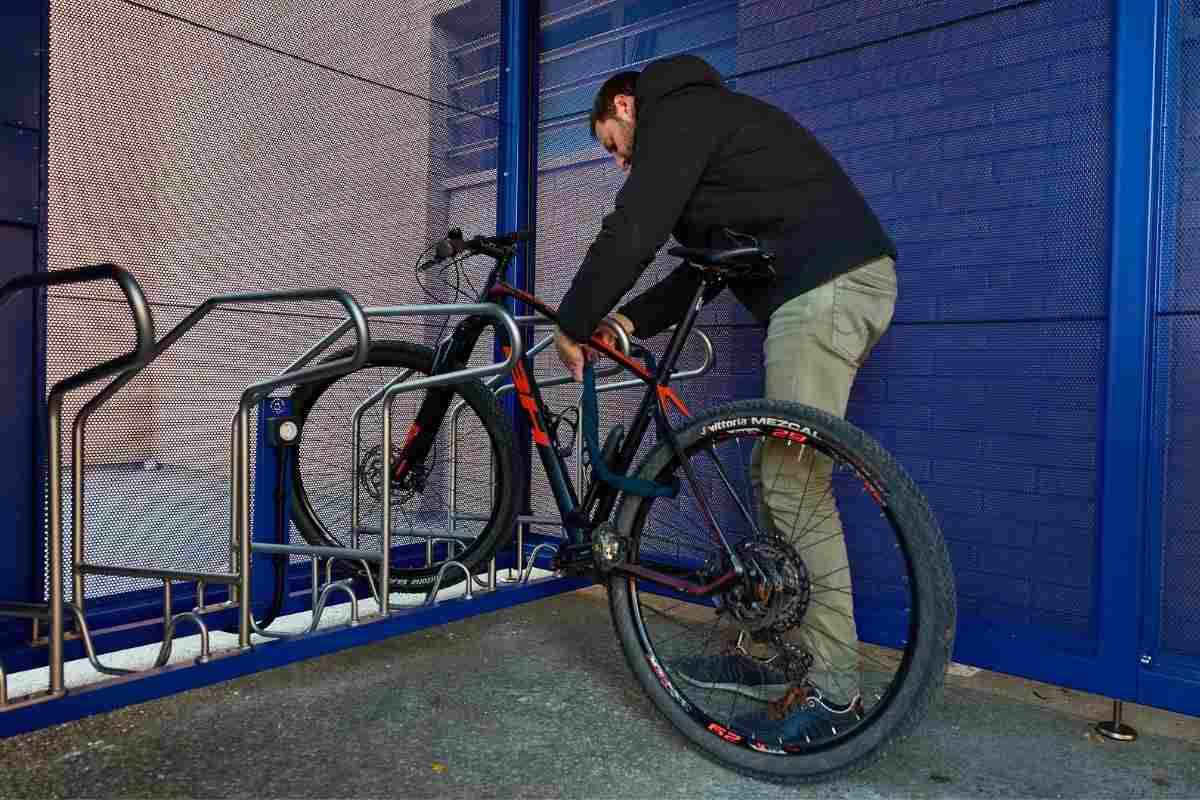
That is why upandbike offers different bike parking and bicycle parking models that can be integrated into each municipality’s mobility network.
- A1 model, an automatic, secure, smart and elevated bike parking system. It can be suitable for urban centres, stations and areas with high footfall or limited available space.
- C Line: includes different modular options, with covered systems, semi-automatic or smart locking systems and capacities that vary depending on the model. These solutions are easy to implement and relocate, allowing them to adapt to neighbourhoods, educational centres, tourist areas, companies or municipal facilities.
- S1 model: a two-tier system that can accommodate twice as many bicycles within the same surface area as conventional parking.
Bike parking should be planned according to the specific characteristics of each space rather than as an identical solution for every environment.
upandbike: solutions to protect citizens’ bicycles
At upandbike, we work to make everyday cycling easier through secure, automatic and smart parking solutions.
Our systems are designed to integrate into towns, cities, universities, companies, stations and public facilities.
Thanks to our bike parking solutions, it is possible to:
- Protect bicycles against theft and vandalism.
- Organise public space.
- Prevent the occupation of pavements and pedestrian areas.
- Optimise available space.
- Facilitate access through smart solutions.
- Adapt capacity to the needs of each environment.
- Complement networks of cycle lanes and cycling routes.
The new regulations represent a step forward in protecting people who travel by bicycle.
Now, the challenge for organisations and local authorities is to support these rules with infrastructure that enables people to cycle and park safely.
Because, for more people to choose the bicycle, they need to feel protected throughout the entire journey and know that, when they arrive, they will find a safe place to leave it.
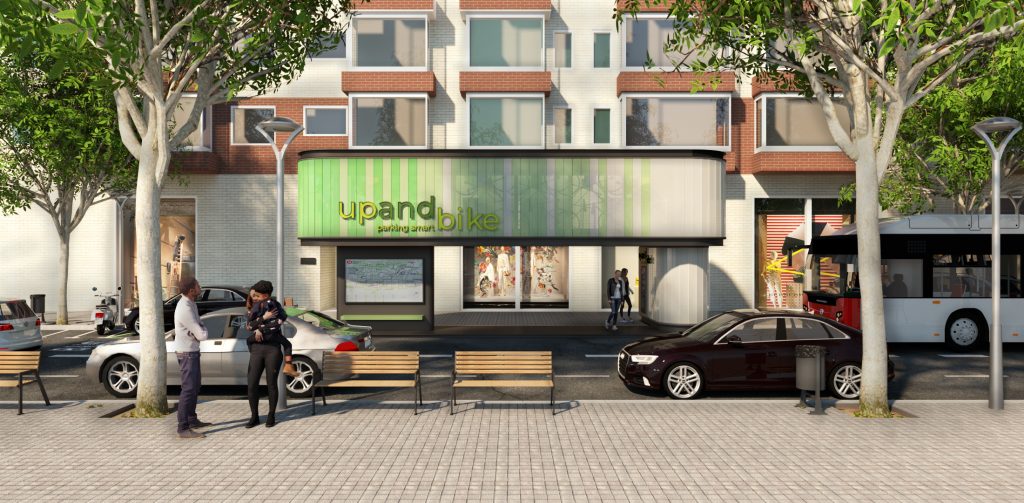
At upandbike, we believe that a more sustainable, safer and pollution-free city is possible.
Road safety, urban planning and bike parking facilities must progress together for cycling mobility to become a real alternative.
A city that protects cyclists and their bicycles is also investing in more efficient, accessible and future-ready mobility.